


Enter here the story title…
Hamodia’s Matis Glenn, Features our E.D. Alexander Rapaport with an Interview Regarding the SNAP Crisis
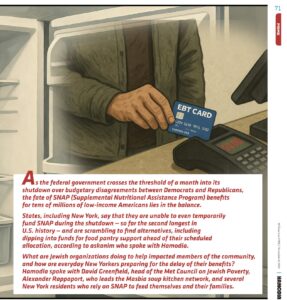
Posted on: November 7, 2025As the federal government crosses the threshold of a month into its shutdown over budgetary disagreements between Democrats and Republicans, the fate of SNAP (Supplemental Nutritional Assistance Program) benefits for tens of millions of low-income Americans lies in the balance. States, including New York, say that they are unable to even temporarily fund SNAP during the shutdown — so far the second longest in U.S. history — and are scrambling to find alternatives, including dipping into funds for food pantry support ahead of their scheduled allocation, according to askanim who spoke with Hamodia. What are Jewish organizations doing to help impacted members of the community, and how are everyday New Yorkers preparing for the delay of their benefits? Hamodia spoke with David Greenfield, head of the Met Council on Jewish Poverty, Alexander Rappaport, who leads the Masbia soup kitchen network, and several New York residents who rely on SNAP to feed themselves and their families.

ALEXANDER RAPPAPORT
What’s your take on the shutdown?
This time it’s a bad one. It’s going to affect food stamps and that’s going to be affecting us locally. We don’t know yet to what degree this is going to affect food stamps but let me sort this out for you. The federal government pays the bill for most food stamps. The state doesn’t. Therefore, if the federal government tells the state that as long as there is a shutdown, they’re going to stop sending the reimbursement, the state needs to find money or shut the program. November 1 is when Washington stopped sending the money. The states will need to decide if they can continue and wait for the government to open. Meanwhile, they have to find different money to run this, because at the end of the day, it is allocated. The funding, as part of budgetary purposes, is there. When the government reopens, nobody is trying to cut food stamps. If [the state] lays out the money, they will get it back. That’s not the issue. That’s where the main focus should be. I would urge Albany that if there is no common sense in Washington, D.C., Albany should at least have some common sense and lay out the money.
What if the state says, “We just don’t have that kind of money”?
Yeah, but I don’t think they don’t have it. They might need an emergency session or something to be able to tap into some money to wait until the federal [money] comes. “Not have” is not the right word. It might just require [getting over] some legal hurdles. The main thing is, the Governor did announce that some of the monies that are out there to help food pantries, which is not a lot, can be brought forward. Meaning, the government usually puts in money for a year or more, and they can choose to spend a little bit every month. They can just bring forward a lot of money that they already allocated, and then let’s see what happens. She announced that on Monday morning. During that announcement, she said that maybe it’s worthwhile looking into school lunch, and what people remember happened with school lunches during COVID, that people were able to take home deliveries, these boxes. She was alluding to that. She didn’t say she wants to do it; she said she was looking into the legalities, if there is a way to use that money and turn that into a bit of a solution. That was coming from her. But I was hoping to hear that Albany would step in.
What will be the immediate results of the loss of funding?
It’s important to note that not everyone gets their SNAP benefits at the same time. Some people get it at the beginning of the month, some at the end. If someone got their last food stamps allocation on October 20, November 1 means nothing to them. So, it’s not that there’s an immediate catastrophe that is going to happen on day one. And even when a person doesn’t have their food stamps, they might still have food. People start becoming desperate only when their pantry gets empty. It’s a trickle-down effect. It’ll take some
time until the groceries decide they’re not going to let people [run a tab] on everything. It’s the first step of the trickle-down effect, not the end step. We are anticipating that if the funding is indeed delayed, we will have to step in in a big way. However, that’s not going to happen the first week. People aren’t going to feel the pinch until a couple of weeks after. We are definitely bracing for it. One of the good things we have is that a lot of the frum families get help from Masbia through DoorDash deliveries. We normally pay DoorDash a non-profit rate of about $5 every delivery. DoorDash announced that they will not charge us starting November 1.
That money lets you buy more food.
That’s exactly it. DoorDash announced they’re going to carry out one million free deliveries for all of America.
I’ve heard from Masbia beneficiaries that deliveries vary. Sometimes staple foods like rice and flour are sent, and other times there are frozen chickens. What sort of foods will you prioritize in a time when people are missing their food stamps?
We operate the deliveries with the idea of [serving] large families. I can say that from the beginning of September until after the Yamim Tovim… a family of 9, 10, or 11 probably got 15 deliveries in one month. If we want to send a family a case of potatoes, which is 50 pounds, we have to divide it in two, because DoorDash only takes 25 pounds. That means, baruch Hashem, a case of grape juice, we can still push. We did send cases of eggs right after Yom Kippur. A lot of things we do are focused on larger [families] because it’s very hard to process. Taking two dozen [eggs] and sending it via DoorDash… it’s complicated. It becomes too small and we have to combine it with
other things. I’ll give you an interesting example. This Sunday, we got a donation from Tirat Tzvi. We got nine pallets of turkey deli, and we sent every family of five and up a whole case. We didn’t pay anything for it; we only paid DoorDash, because [the food] was donated. This was a donation, but when we purchase, we try to maximize our dollars. We used to buy a lot of eggs because that was the “poor person’s protein.” But then it became very expensive. Baruch Hashem now it’s coming back down and is more rea-
sonable. Every day, we look at the food categories, fruits and vegetables, grain, and protein, and we try to get the best in those categories. So it’s fungible for us within a category.
Wherever you can get it cheaper in that category.
Exactly. Pre-Ukraine war, we sent out a crazy amount of flour. We constantly pivot within a category to find the better items. Also, a lot of the food is catered to the kosher consumer, where we spend most of our dollars. To get kosher chicken, to get the things that are not [in the general system]. To get potatoes… there are usually some potatoes in the system somewhere, between City Harvest, Food Bank, this one, that one. I try to chase everything down. For the frum food, it’s hard. That’s where most of our [spending] is. We are anticipating that if the funding is indeed delayed, we will have to step in in a big way. However, that’s not going to happen the first week. People aren’t going to feel the pinch until a couple of weeks after.
To sponsor Masbia Soup Kitchen click here.